




Nonprofit Org.
U.S. Postage
PAID
Platteville, WI
Permit No. 7
500 E. Market St.
Iowa City, IA 52245
Pediatric clinic offers evening hours
SEE PAGE 2
Weight loss success stories
PAGE 5
In praise of pumpkins
PAGE 8
Food safety
musts for
moms-to-be
A
s a mom-to-be, you know a
healthy diet is a must for
both you and your growing
baby. But an extra safe diet is also
essential—one that protects the
two of you from food poisoning.
Food poisoning is never a good
thing. But it’s especially risky now
that you’re expecting. Pregnancy
alters your immune system, mak-
ing it harder to fight off harmful
bacteria and other microorganisms
that can multiply in food and make
you seriously ill.
What’s more, even if you have
no outward symptoms after eating
contaminated food, your unborn
child can still be harmed. Among
other things, foodborne illnesses
can cause a miscarriage, early
labor or stillbirth.
So take extra care to keep you
and your baby safe. Here’s how:
Wash those hands.
With
proper handwashing, nearly half
of all cases of foodborne illnesses
might be eliminated, according to
the Academy of Nutrition and Di-
etetics. What’s a proper cleaning?
Scrub your hands regularly with
warm, soapy water for at least
20 seconds.
Separate.
Bacteria from raw
meat, poultry or seafood can
contaminate ready-to-eat food.
So keep these foods apart. That
means using one cutting board for
raw foods and another for foods
such as fruit, vegetables and
bread.
Toss it.
Perishable foods that
have been left out at room tem-
perature for more than two hours
aren’t safe to eat.
Avoid it.
Certain foods are
off-limits during pregnancy. On the
list: raw or undercooked meat and
poultry (such as rare hamburgers);
fish with high levels of mercury
(such as swordfish); foods with
raw or undercooked eggs (such
as runny eggs); and unpasteurized
dairy products (such as raw milk
or cheese).
Additional source: U.S. Food and Drug Administration
n a Thursday morning in late spring, Ben
Stevens, MD, is visiting with a tired young
couple in Mercy’s Maternity Unit. Their new-
born son is fighting an infection, and he is
receiving around-the-clock attention in
Mercy’s nursery.
✦
Dr. Stevens explains the
situation in his gentle manner and ends on a positive
note.
“He’s going to be okay,” he says, patting the distraught
mother’s shoulder. “Why don’t you go visit him?”
Dr. Stevens next moves down the hall—greeting a
new father, who has a Chicago Bears blanket wrapped
around his shoulders, and answering questions about
circumcision with another couple. In the Pediatric Unit,
he laughs with a red-haired 8-year-old boy recovering
from a respiratory virus. Then he returns to the nursery
to check the results of blood gas tests for two newborns.
It’s a typical day for Ben Stevens, the head of Mercy’s
new pediatric hospitalist program. In this role, Dr. Ste-
vens is developing a new service that will provide area
physicians support for their young patients and enhanced
care in Mercy’s nursery for premature and sick newborns.
Like most medical students, Dr. Stevens explored many
different facets of medicine. But he always enjoyed tak-
ing care of children, so pediatrics was a natural choice
when he completed medical school in 1997. (Kids keep
him busy at home too; he and his wife, Candice, have five
children, ages 9 to 22.)
“Kids are very resilient,” says Dr. Stevens. “Their out-
look is basically hopeful, and when they are sick, they
always want to get better.”
“Pediatrics is a challenging and rewarding field,” he
continues. “It provides a chance to make a difference in
a baby’s life and a family’s life.”
N E E D A P H Y S I C I A N ? C A L L M E R C Y O N C A L L AT
3 1 9 - 3 5 8 - 2 7 6 7
O R T O L L - F R E E AT
8 0 0 - 3 5 8 - 2 7 6 7
S E V E N D AY S A W E E K .
●
S U MM E R / FA L L 2 0 1 5
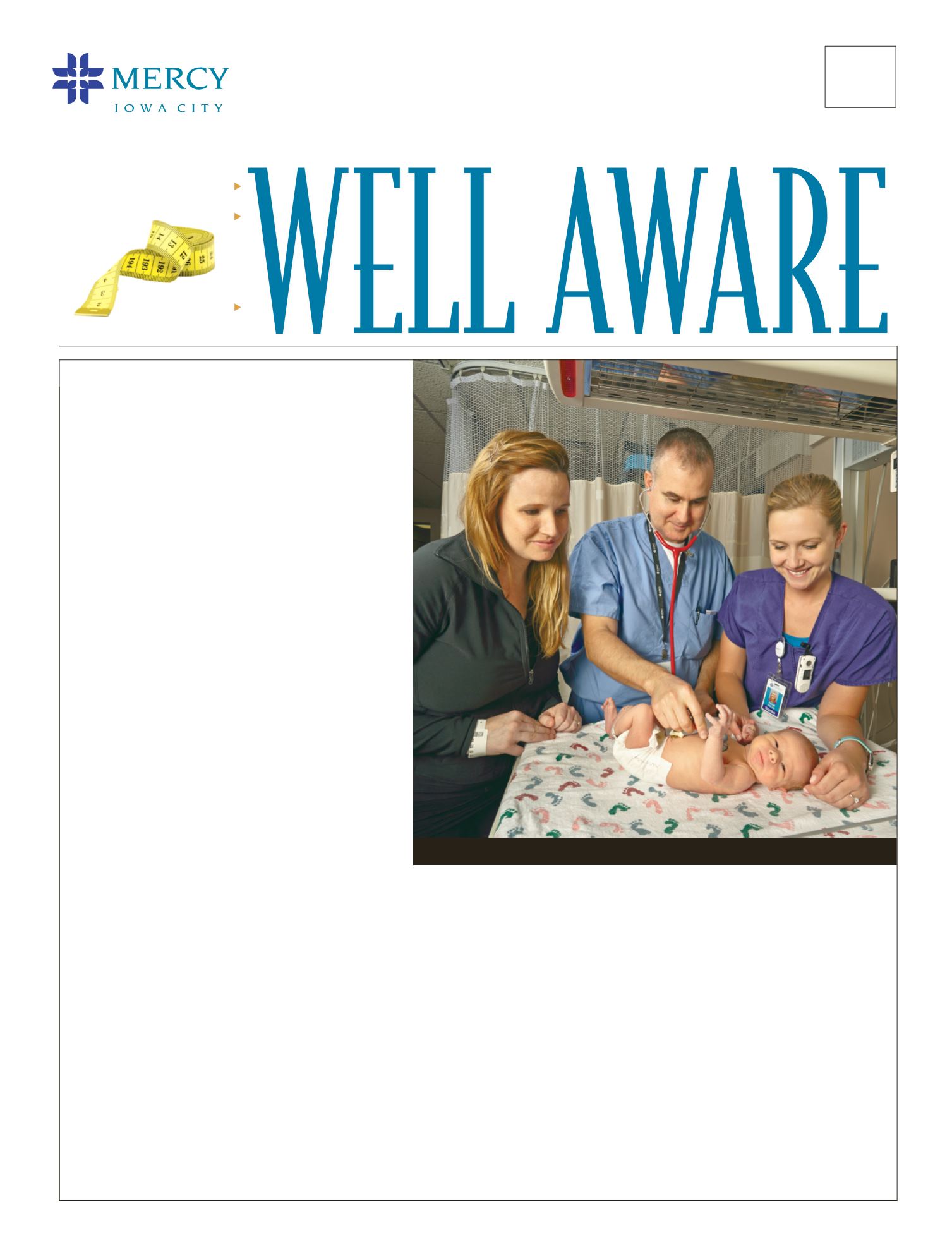
IN GOOD HANDS: With mom Julie Wees and staff nurse Anna Keehn, BSN, RN, looking on,
Ben Stevens, MD, examines newborn George in Mercy’s nursery.
O
Pediatrician
enjoys
making a
difference
—Continued on page 2